
The ad was direct: 1,000 subscribers, 4,000 watch hours, "100% organic," "safe for YouTube policy," 24/7 support. A "Send message" button sat underneath it. I sent one — as a genuine prospect, not a competitor fishing for secrets. I just wanted to know how the process actually worked before paying for it.
That one question turned out to be the entire story.
The Pitch
Before a single question got asked, two packages were already on the table: ₦139,000 for 1,000 subscribers plus 4,000 watch hours, or ₦76,000 for watch hours alone. Then, almost immediately, a nudge to place the order and let the "work record" page settle any doubts. Pricing and social proof arrived before process did — the same order the ad itself used.
Three Reassurances Before One Real Answer
Asked whether the process even fit a channel that didn't exist yet, the replies came in layers — each one more emphatic than the last, none of them more specific:
- "Yes sir we do organic promotion so all subscribers and 4k watch hours are organic non drop and comes with life Time guarantee."
- "We are following the required process and guidelines correctly according to YouTube policy. So your channel is safe too."
- "We use organic promotion methods focused on real audience engagement and genuine viewer activity. We do not use bots or fake engagement."
Three separate messages, three separate reassurances, zero mechanisms. It took a forced-choice question — ads, channel optimization, or a third-party indexing tool, pick one — to get past the adjectives: "an organic process that includes channel SEO, hashtags and live streams promotions." Still soft, but it was the first sentence in the whole conversation naming an actual activity instead of a virtue.
A screenshot arrived right behind it, captioned "the audience source of our promotion" — offered as evidence for exactly that claim.
The One Precise Number in the Whole Conversation
Ask about timeline, though, and the vagueness disappeared instantly: order completion in 10–15 days, visible progress in 6–7. No hedging, no reassurance language — just a number.
That contrast is the real tell. Three messages of adjectives to describe how the service works, one clean sentence to describe when you'll see results. Certainty gets spent on the thing that creates urgency, not the thing that builds understanding.
A Real Answer, Buried in a Deflection
The next question had three parts: why pay at all, what happens to the money without results, why not just learn it myself. The first reply answered none of it — "we're offering services, we're not offering classes for youtube course" — until a second push surfaced something real: "our goal is to deliver satisfactory results and to build long term working relationship with all our clients. In case of no results you can claim refund."
Worth being fair here: a refund claim is on the record. It just took a second nudge to say it, and it named a policy without ever naming a process — no timeline, no conditions, no "how." Compare that to the ROI number two messages earlier, and the pattern holds: specific where it's persuasive, vague where it's accountable.
The Composed Answer That Almost Held
Pushed once more on paying versus self-teaching, the reply was, honestly, the best one in the whole conversation: learn it yourself if you have the time, no hard feelings — otherwise, that's what you're paying someone else's time for. Reasonable, unhostile, well put. This is the point where the conversation could have ended as an ordinary "not a fit right now, thanks." It almost did.
The ₦76k Echo
What followed instead was unsolicited: a breakdown of the AIDA framework — hook, problem, solution, proof, call to action — offered as friendly advice on how the pitch should have gone, complete with a hypothetical: would you pay ₦76,000 for a phone brand you'd never heard of, with no explanation given first?
The number wasn't random. It was their own price for the watch-hours-only package, handed back as a thought experiment — their own pricing, used against them, phrased as a general marketing observation instead of a direct callout.
The reply drew a clean, entirely fair line: "I have already answered the query you asked. I think we should focus on the actual matter… for which you came here in the first place." A business declining a tangent isn't a trust failure — that part of the transcript is a good boundary, not a bad one. It should have been the end of it. It got a "good day" in return, and the conversation was, at that point, already over.
The Turn
It didn't stay over. The very next message, unprompted, reopened it: an accusation of posing as a customer to reverse-engineer someone else's sales script. One honest reply later — confirming part of it, helping other providers, alongside genuine curiosity — came a clarifying question: service, or scrutiny?
"The latter."
Then it dropped entirely: "you're here because you don't have clients… you failed thats why now you're trying to get answers from other service providers… Don't worry I'm your father in this field."
The distinction matters. The business wasn't cornered into this. It had already won the exchange — held its boundary, ended the conversation on its own terms, gotten a polite goodbye. It came back anyway, to diagnose the customer instead of accepting the win.
The "Proof" That Argues Against Itself
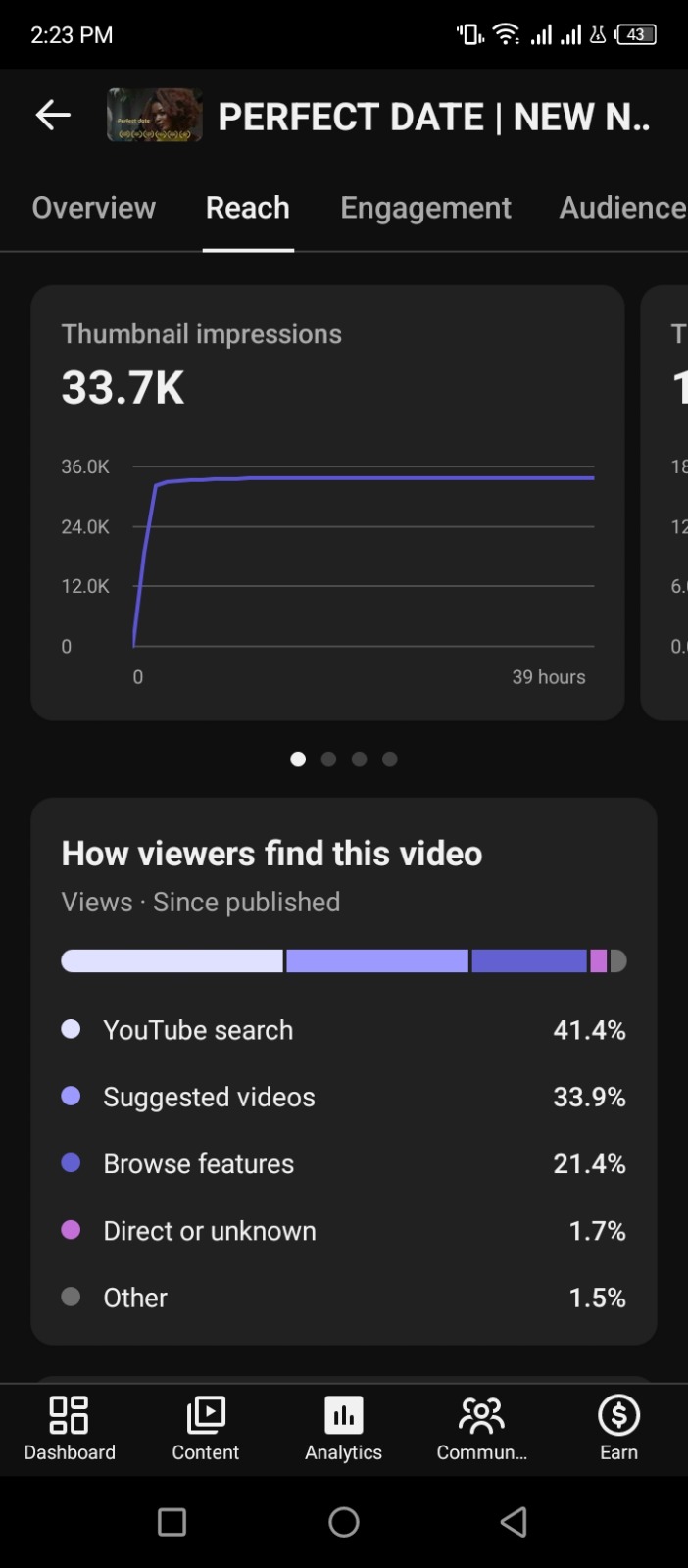
The screenshot sent as evidence of "real audience engagement" showed impressions on a video climbing to roughly 33,700 within about the first hour of a 39-hour window, then flatlining completely for the rest of it. Organic algorithmic distribution doesn't move that way — it tests a video in waves, climbing in stages as it reaches new pools of viewers over time. One vertical spike followed by a dead flat line looks like a single batch of impressions landing all at once, which is closer to the thing this business had explicitly denied doing than the thing it was using the screenshot to prove.
Erasing the Evidence, Badly
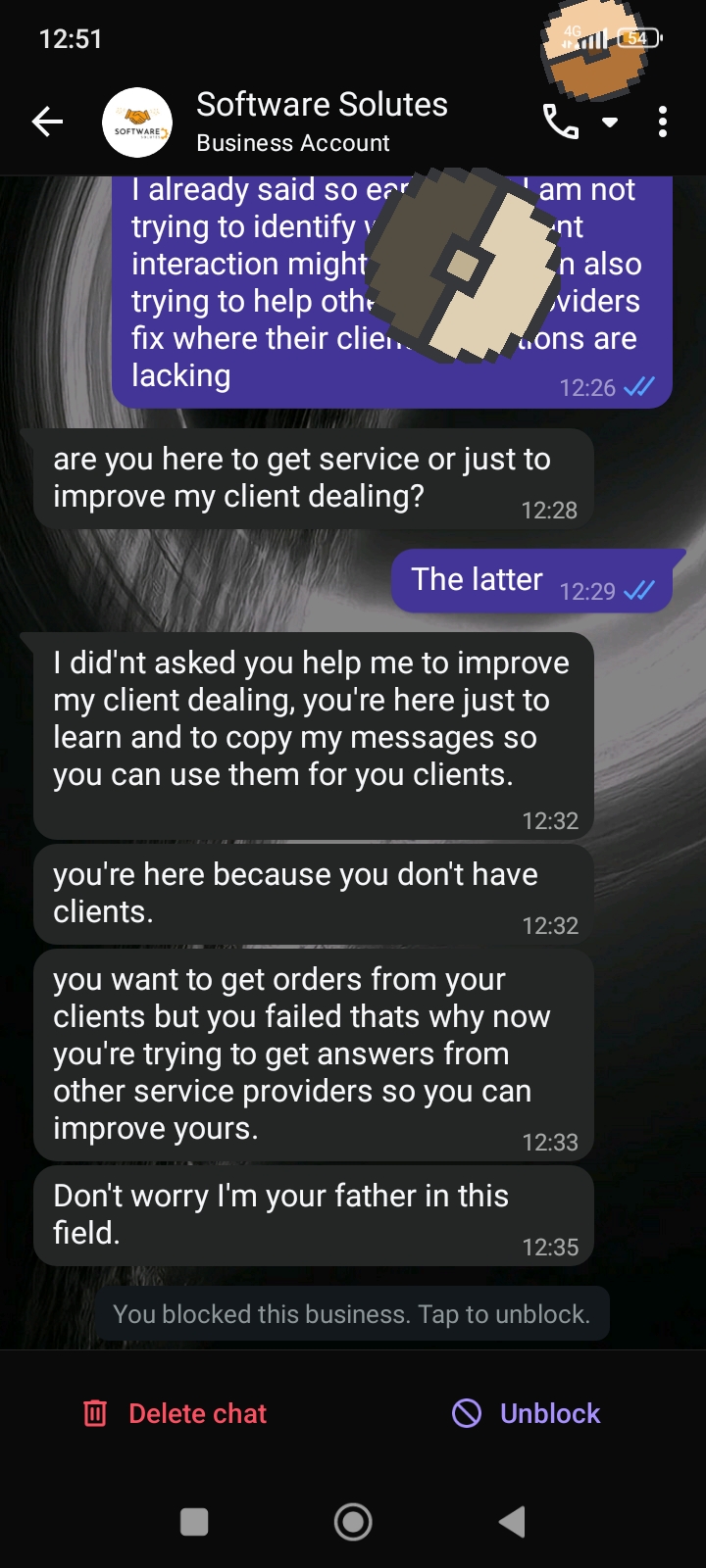
After the block, several of the business's own earlier messages quietly turned into "This message was deleted" — including some of the ones quoted above. Nothing wrong with deleting a message on its own. But the conversation had already been exported in full beforehand, a standing habit for chats like this one. The deletions didn't remove anything from the record. They just added one more data point: something in there, on reflection, didn't sit right with whoever sent it.
The business was briefly unblocked — long enough to receive its own complete, undeleted export back as a parting message — then blocked again.
What Actually Broke Trust Here
- Adjectives aren't a process. "Organic," "safe," "policy-compliant" took three messages to arrive at one sentence describing an actual activity — and only because the question stopped allowing a soft answer.
- Precision reserved for urgency is a tell. Exact on the timeline, vague on the refund mechanism and the method — that asymmetry says more than either answer alone.
- A good boundary is not the same as a good ending. Declining a tangent was the right call. Reopening it unprompted to question the customer's motives, after the customer had already left politely, is what actually cost the sale.
- Deleting evidence doesn't erase doubt — it confirms it. If the original messages were defensible, there'd have been nothing to walk back.
Users rarely abandon because they don't understand — they abandon because they stop believing.
The Landing Page He Never Got
There's one more detail worth sitting with. This conversation started as more than a customer inquiry — it was meant to be a pitch for a free landing page, one of ten being built in exchange for an honest review. The business held its ground for most of the conversation, then gave it up in the last five minutes, unprompted, over a question it had already technically answered. That cost more than a sale. It cost a project, a portfolio piece, and — now — a public teardown of the exact conversation that ended it.